


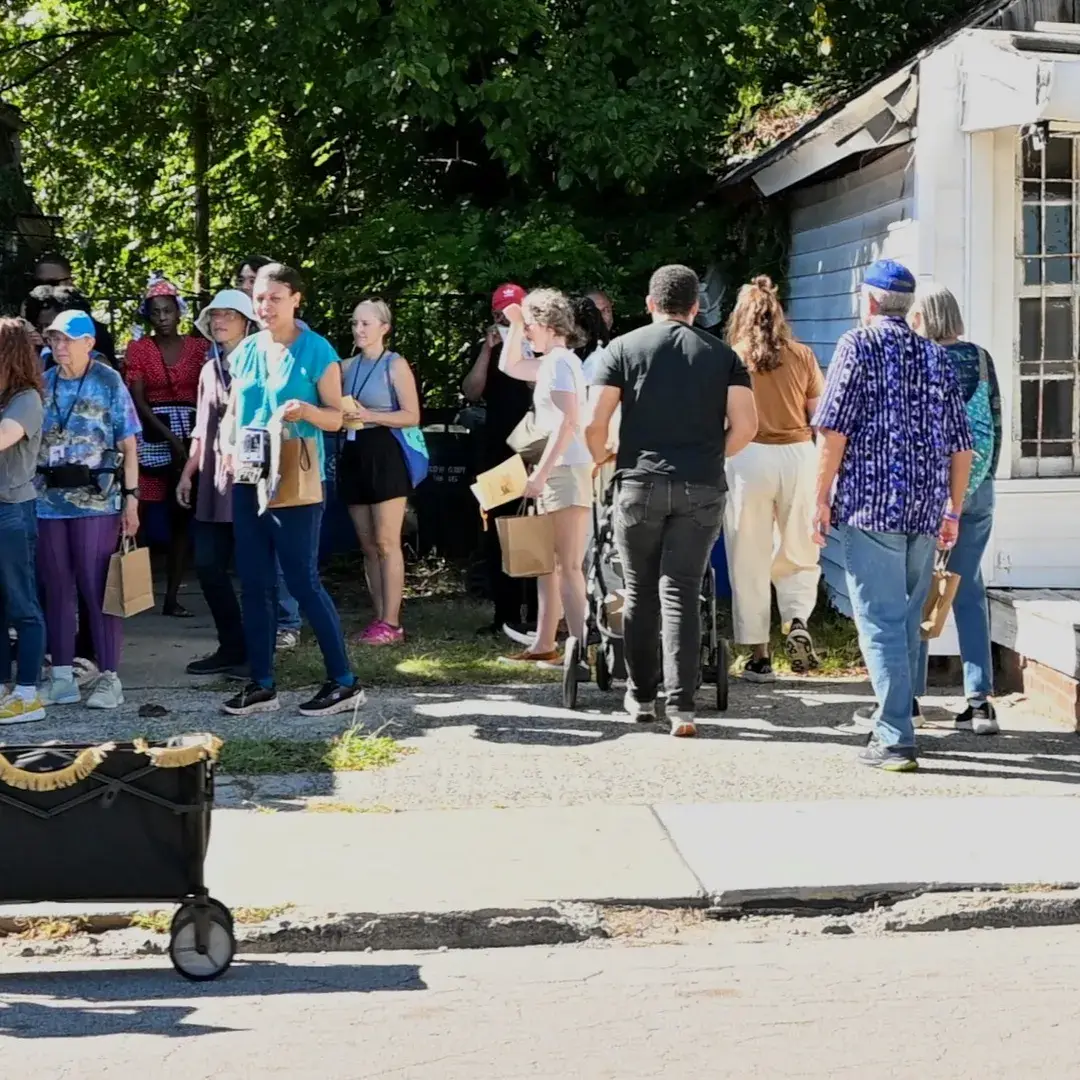
March is Women’s History Month, and in our office we’ve been reflecting on the many women who shaped the Fayetteville Street Corridor, historic Hayti, and Durham at large. As we’ve dug deeper into the residents of the historic homes along the corridor, a clear theme has emerged: story after story of remarkable women whose contributions have too often gone unrecognized. When we talk about Durham’s Black Wall Street and its entrepreneurial legacy, these women’s voices are rarely centered, yet they were essential to that history.
Uncovering and sharing these stories is central to our work. You’ll see this commitment reflected in the historic plaque campaign we’re launching with Hayti Promise CDC, as well as in the walking tour we’re excited to be developing in partnership with Whistle Stop Tours, debuting later this summer. We’re beginning to feature more of these histories on Open Durham so keep an eye out for new updates each week.
In the meantime, be sure to check out the highlight later in this newsletter on Dr. Malevia Dye Pearson who lived at 1215 Fayetteville Street. Dr. Pearson became one of the first Black female pharmacists in 1911 and co-owned the Hayti Drug Store at 618 Fayetteville Street with her husband. History does not need to be rewritten; it needs to be uncovered and shared. We are honored to help bring these stories to light.
With gratitude,
Join Preservation Durham as we celebrate the 100th anniversary of Hope Valley with this year's home tour! Started in 1926, the community was built around the Hope Valley golf course, and was explicitly designed to accommodate the rise of the automobile in the early twentieth-century United States. From its inception, Hope Valley has been defined by incredible period revival homes; many of the originals designed by Durham architect George Watts Carr. Hope Valley is one of the twenty national register historic districts in Durham, an indication of its rich and integral role in Durham's history.
To celebrate Hope Valley's centennial, Preservation Durham is hosting our 2026 home tour in the neighborhood. The eight homes on this tour, all spanning from within 10 years of the neighborhood's establishment, represent the vision the Hope Valley designers had for the professional-class neighborhood.
The home tour takes place on May 16th-17th, 2026, from 12-4pm each day. Early bird tickets are on sale now, with a discount for Preservation Durham members. General public ticket comes with a one-year membership to Preservation Durham. This offer is for new members only and cannot be used to renew an existing lapsed membership. Ticket prices will increase starting April 1st.
Sponsorship Levels:
Presenting Partner: $7,500
Preservation Champion: $5,000
Preservation Partner: $2,500
George Watts Hill Circle: $1,000
Preservation Advocate: $750
Preservation Friend: $500
*Advertisement options in
Home Tour program booklet
If you’re interested in joining our community of sponsors and supporting Preservation Durham’s work and programs in 2026, including receiving benefits at the annual home tour featuring Hope Valley’s Centennial May 16-17, reach out to Julianne Patterson or click here to learn more.
Presenting Partner
Preservation Partner
George Watts Hill Circle
Preservation Friends
Exhibit Opening Recap
We Built This: Profiles of Black Architects
and Builders in North Carolina
Produced by Preservation North Carolina, and appearing in Durham for the first time, “We Built This” highlights African Americans who designed and constructed many of the state’s most treasured historic sites. Spanning more than three centuries, the exhibit features more than two dozen personal profiles and explores pivotal eras and themes, including slavery and Reconstruction; the founding of historically Black colleges and universities and Black churches; Jim Crow and segregation; and the rise of Black civic leaders, politicians and professionals.
Many of the historic buildings we revere in North Carolina are credited to their owners. Rarely are the people responsible for the labor and craftsmanship recognized. We Built This seeks to acknowledge the countless African Americans who built the historic buildings we collectively treasure. These individuals were skilled in principles of engineering, construction and business. Many became political and social leaders in their communities. Acknowledging the significance of this history is a start to preserving a tangible link to the past through our built environment.
Courtesy of NCCU
Exhibit will be on display through March James E. Shepard Memorial Library, NCCU
Preservation Durham board members, staff, and interns at the opening ceremony on February 6, 2026
“The exhibit features historic people such as John Winters, a home builder who was the first African American on Raleigh’s City Council; Bishop Henry Beard Delany, who oversaw the building of Saint Augustine’s University campus in Raleigh; John Merrick of Durham’s Black Wall Street, who created the North Carolina Mutual Life Insurance Company; and Julian Francis Abele, the chief designer of Duke University’s West Campus and Duke Chapel.” Check out WUNC reporter Aaron Sánchez-Guerra’s full article with interviews with community members at the opening ceremony.
The City of Durham in partnership with Ira Knight Presents seeks actors to perform scripted biographical monologues and one collaborative scene for an onsite living history event at Beechwood Cemetery, located at 3300 Fayetteville Street, Durham. Beechwood Cemetery was founded in 1924 to serve Durham’s community. Over a century later, it remains a place of remembrance and history. Auditions will be held on Thursday, March 12 at Durham City Hall. Actors will portray prominent figures laid to rest at Beechwood and share their stories with audiences in an onsite outdoor performance. The event will also be documented on video.
Audition Details
- Thursday, March 12th, 3pm–7pm
- Durham City Hall, GA Room (1st Floor) 101 City Hall Plaza, Durham
- Please prepare to perform the following: A one-two minute memorized monologue, or a cold reading (sides available at the audition)
Rehearsal & Performance Details
- Performance Date: May 20, 2026 (Rain Date: May 27, 2026)
- Rehearsals: April-May 2026 (schedule provided upon casting)
- Compensation: $250 stipend per actor
Roles
- John H. Merrick: Business leader, co-founder of North Carolina Mutual Life Insurance Company, and central architect of Durham’s Black Wall Street.
- Aaron McDuffie Moore: Physician, community leader, and co-founder of North Carolina Mutual.
- James E. Shepard: Educator and founder of the National Religious Training School, which became North Carolina Central University.
- Viola Turner: First female member of NC Mutual's Board of Directors.
Opportunity to own a unique piece of Durham history!
The Historic White Cross Community Center log cabin built by the
Works Progress Administration (WPA) in 1935 and protected by
Preservation Durham is for sale: 4514 Erwin Road
This unique historic property is protected in perpetuity by a preservation easement held by Preservation Durham. To request a copy of the easement or ask questions, please contact Julianne Patterson. Listed with Courtney Brown at Peak Swirles & Cavallito, reach out to her directly if you’re interested in this historic log cabin between Mt. Sinai Road and West Cornwallis Road. The property is listed for $405,000
Aubrey St. Clair and Sarah Nurse were the original owners of 1215 Fayetteville, living in the home when it was built in 1920. Aubrey was a dentist, and Sarah was a domestic worker. Their two daughters, Catherine Frances Nurse and Doris St. Claire Nurse, were both born while the Nurses lived in the home.
Drs. John Westley (J.W.) Pearson and Malevia Pearson moved into the home in 1927. The Pearsons, along with their daughter, Cynthia, lived in the home until Malevia died in 1959. John Westley was the brother of William Gaston (W.G.) Pearson, one of the numerous individuals who were integral to the success of Hayti as a beacon of Black wealth. W.G. was the principal of Whitted High School, the first African-American Graded School. He was then principal for 30 years at Hillside High School. When a new school for Black students was built in 1928, it was named after W.G. Pearson, “Durham’s Black Superintendent.”
W.G. and J.W.’s parents were enslaved, and W.G. was born enslaved. J.W. was born after the Emancipation Proclamation, so he was likely never enslaved. J.W. and his wife, Malevia Dye Pearson, were both pharmacists and owned Hayti Drug Store located at 618 Fayetteville Street. Malevia was cited as one of the first Black, female pharmacists. She attended Meharry Medical College, where she earned her Pharmaceutical Sciences degree. J.W. and Malevia moved to Durham together in 1913. The store was built in the early 1920s and was the Hayti Drug Store until 1941. It was then home to numerous other businesses until the late 1960s-early 1970s, when it was demolished.
For more information, check out the updated Open Durham page for the Nurse-Pearson House
The Nurse-Pearson House is a rare surviving Durham example of a kit house sold by Sears, Roebuck and Co. in the early 20th century. This vintage advertisement shows the matching plan for "The Westly," a seven-room bungalow.
This charming Tudor Revival home was one of the first houses built in Hope Valley designed by George Watts Carr. The elegant half-timbering and clipped gable roof peaks reflected the developer, Mebane & Sharpe’s vision for the neighborhood. The engaged shed-roof porch and use of multiple different building materials such as brick and stucco give this home style and character that inspired future homes in Hope Valley. Dr. William and Katherine Brownell were the first owners of the home, while William worked as an education professor at Duke University. Later owners rehabilitated the exterior and interior, including installing a solid Tudor-style wood door, woodworking, stone mantelpiece and separated garage.
The Edward S. Orgain House was built in the late 1930s for Duke economist Herbert and Guelda von Beckerath. The home was designed by George Watts Carr who ran his own renowned architecture practice in Durham from 1927-1961. This Colonial Revival style home has an asymmetrical facade created with a mixture of materials and architectural detail that was unique from the more formal symmetrical style of many other Colonial Revival houses of the time. The Beckeraths sold the home to Dr. Edward and Anne Orgain in 1944 who added a rear wing to the house several years later with a new master suite and living room finished with vertical fir wood paneling.
More recent owners restored the wood siding, wood windows, and enlarged the kitchen with Durham architect Steve Gaddis, who carefully retained the feel and charm of Carr’s original plan with these sensitive additions. The Orgain house will also be on the 2026 Home Tour in Hope Valley.
Featured 24 years ago in the Preservation Durham 2002 Hope Valley Home Tour
Local events and news from us and our partners in preservation you may be interested in.
- The James E. Shepard Memorial Library at North Carolina Central University (NCCU), in collaboration with Hayti Promise Community Development Corporation and Preservation Durham, is elevating the stories of Black architects, builders and craftspeople who helped shape North Carolina’s historic landscape through the traveling exhibit, “We Built This: Profiles of Black Architects and Builders in North Carolina.” The free exhibit will be on display until March 31st, in the James E. Shepard Memorial Library, located at 209 Eagle Campus Drive.
- Tax Credit Workshop at Forest Hills Club House, Wednesday March 4, from 7pm-8:30pm
- Hayti Heritage Film Festival, March 4-7. For over a decade, the Hayti Heritage Film Festival (HHFF) has showcased Southern Black cinema, centering stories that challenge, affirm, and expand cultural narratives. This year’s expanded program commits more deeply to HHFF’s mission to serve as a teaching festival designed to educate, inspire, and uplift the next generation of southern storytellers. With post-screening discussions, artist talks, and tributes, the festival weaves themes of memory, migration, and Black futurism into an unmissable experience for cinephiles and changemakers alike.
- Women's History Month Guided Tour at the Pauli Murray Center. Saturday, March 7th, 10am-12pm. This tour will be hosted by Executive Director, Angela Thorpe Mason, and will focus on key pieces of Pauli Murray's life and legacy in the Women's movement. Visitors will be guided through the interior exhibit and historic space, and time for questions and interactive reflection will be included in the time spent together. Registration is required.
- Beechwood Cemetery Living History Performance Project Auditions on Thursday March 12, from 3pm-7pm
- RTP and Durham History Trivia Night Join the Museum of Durham History at Glass Jug Beer Lab on Thursday, March 12th from 6:30-8:30pm for an exciting RTP and Durham History Trivia Night with Bull City Discovery Society. Compete with friends and meet new folks while you enjoy some fantastic drinks and show off your Durham knowledge. Plus the top 3 winners will receive Museum of Durham History swag bags.
- Join the Merrick-Moore Community Development Corporation (MMCDC) on the third Tuesday of every month for engaging community meetings. Each session showcases guest speakers who provide valuable resources and information beneficial for both community members and MMCDC. Snacks and refreshments are provided at Mount Zoar Missionary Baptist Church.
- "Her Heart is Slowly Breaking:" a Women's History Tour of Stagville. Explore the resistance, resilience, love, and labor of enslaved women on one of the largest plantations in NC. This March, visit Historic Stagville for a special guided tour of the Bennehan House and grounds featuring the stories of enslaved women from Stagville. This tour highlights the lives of Phoebe Bennehan, Anna Bell, Emma Turner Henderson, and more. Their personal stories, reconstructed with careful research, illuminate the experiences of countless women who endured bondage in North Carolina. Offered each Saturday in March, at 11am.
- Duke Chapel tours: Learn about the history, architecture, and life of Duke Chapel in this docent-led tour offered regularly every Sunday after the 11am worship service, which ends at approximately 12:15pm. Tours last approximately 45 minutes, and are free and open to the public.
Copyright (C) 2026 Preservation Durham. All rights reserved.Want to change how you receive these emails?
You can update your preferences or unsubscribe