Back in 2024, my first year with Preservation Durham, the organization celebrated its 50th anniversary. As I dug into the organization’s history for that milestone year, I kept coming back to a quotation from our founder Margaret Haywood (1915–2014): “The impetus for forming the society had less to do with opposition than celebration.”
That idea stayed with me over the last two and a half years.
Preservation work can often feel reactive, responding to threats, advocating for vulnerable places, navigating difficult conversations about growth and change. But at its core, preservation is about people caring enough to celebrate what makes Durham, Durham. That spirit is what brought nearly 600 people together to form this organization in 1974, and it’s still what drives the work today.
I remember being struck by the fact that Preservation Durham signed on nearly 600 charter members in its very first month. At the time, I quietly set a goal to help build membership back to that number during my time here. As I write my final newsletter before stepping down as Executive Director at the end of this month, we are now only about 50 members away (!!!) from reaching that goal.
Over the last few years, we’ve built new partnerships with neighborhood groups, preservation advocates, universities, tradespeople, and community organizations across the city. We welcomed new staff, expanded programming, and continued to grow membership and outreach at a time when many nonprofits have struggled to reconnect after the pandemic years.
We also spent time rebuilding some of the organization’s traditions and public presence. We rebooted the Preservation Awards program (nominations open now!) and brought back the fall Preservation Party as opportunities to celebrate the people doing preservation work every day across Durham. Along the way, we saw important advocacy wins, continued expanding our easement and stewardship work, and pushed conversations around equitable preservation further into the foreground.
When I arrived at Preservation Durham, I wrote that it was easy to look around at the pace of development in Durham and feel like preservation was losing ground, yet 2.5 years later, I still think we have more to celebrate than mourn. Durham’s preservation movement has continually evolved because people continue to care deeply about this city, its neighborhoods, and its history.
As Preservation Durham prepares for its next chapter and a new Executive Director, I hope you’ll consider helping us close out this fiscal year strong and reach that symbolic 600-member goal once again. If you’ve been thinking about renewing your membership, becoming a first-time member, or making a donation to support the organization’s work, now is a meaningful time to do it. The successes of the next 50 years will not happen alone.
Thank you for trusting me to help steward this organization for a small part of its history. I’m deeply grateful to the staff, board, members, donors, volunteers, and community partners who made this work possible, and I’m excited to see where Preservation Durham goes next.
With gratitude,
A Warm Welcome for Three New Board Members to Preservation Durham’s Board of Directors
Eric Thomas is an Associate Director at the Development Finance Initiative (DFI), where he helps local governments across NC advance community and economic development projects. He’s led work in downtown mixed-use development, brownfield redevelopment, and historic preservation since joining DFI in 2015. Eric is an adjunct faculty member at UNC-Chapel Hill, teaching Sustainable Design since 2017. He holds degrees from Brown University, UNC-Chapel Hill, and NC State University.
Michelle Burton was elected to the Durham County Board of Commissioners in 2024 and is serving her first term since retiring from Durham Public Schools after a 30-year career as a public school educator and library media coordinator.
Michelle is the former president of the Durham Association of Educators and a founding board member of the Durham Public Schools Foundation. She currently serves as Vice-Chair of the North Carolina Foundation for Public School Children. Michelle holds degrees from UNC-Chapel Hill, and NC Central University.
Ryan Gray is passionate about making Durham’s history accessible to all residents. He has a lifelong interest in local history and architecture, inspired by growing up in a historic home. Ryan is a Strategy and Operations consultant specializing in analytics and public data insights, with an M.S. from Duke University. Ryan’s family roots in Orange County date back to the 1700s, and he now lives in Durham with his partner and dog.
We greatly appreciate the time, energy and preservation passion from board members whose term recently ended. A huge thank you to Faye Calhoun, Patricia Harris, Austin Moore, Marshall Williams, and Dr. Charles Johnson for their years of dedication to Preservation Durham and their community.
Our community gathered for a great evening of fellowship and preservation updates. Many thanks to Lee Pace, author of Hope Valley Country Club: The First One Hundred Years, 1926-2026, and Tad DeBerry for presenting fascinating history of the Hope Valley neighborhood and golf course. We appreciate all the folks who came to our annual meeting and home tour lecture at the Hope Valley County Club on May 12th.
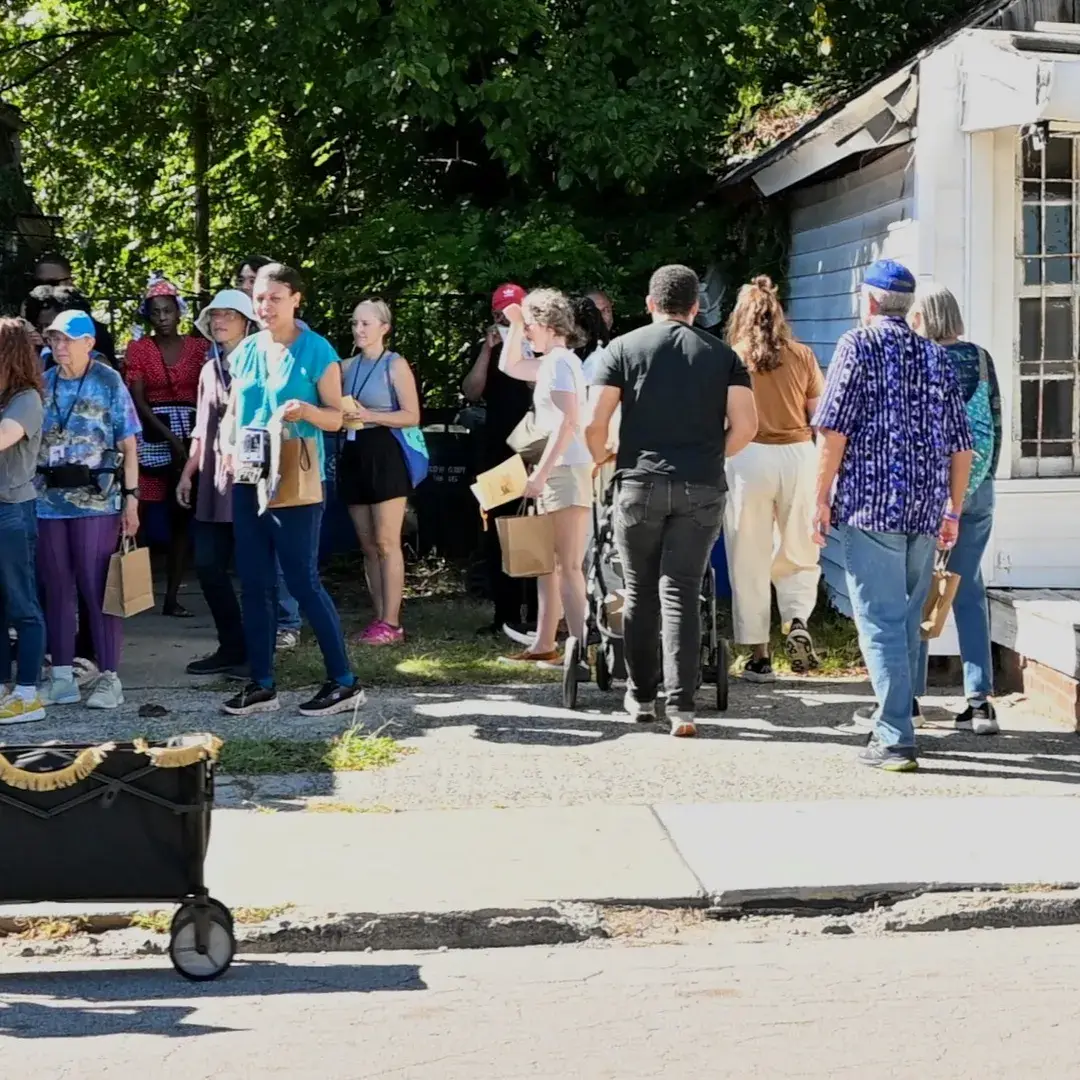
Preservation Durham’s annual home tour on May 16th and 17th featured eight beautiful homes in the Hope Valley neighborhood in celebration of Hope Valley’s centennial. Thank you to the amazing home tour committee, volunteers, and homeowners who made this event possible. We look forward to seeing you at Preservation Durham’s next annual home tour in May 2027!
The Herald Sun, 1928
Hope Valley is the culmination of the efforts of Durham’s early 20th century social and business leaders, a visionary Duke physician, two bold real estate developers, willing farmers, and a handful of intrepid suburban pioneers. Since 1926 each decade has put its stamp on Hope Valley. The 1920’s saw a magnificent Aymar Embury II Clubhouse, a beautiful residential park designed by Robert Cridland, and of course a show stopping Donald Ross golf course. Homes during this era were largely designed by Durham’s George Watts Carr, but notably there were three homes designed by the renowned Charles Barton Keene.
Explore homes featured in tours from previous years (and decades) on OpenDurham.
Presenting Partner
Preservation Partner
George Watts Hill Circle
Preservation Friends
We’re excited to offer one of our most popular tours this summer, our architecture walking tour! Learn more about many of Durham's most iconic landmarks in the Downtown Durham area. Robert Sotolongo, retired president of DTW Architects, will host the tour, sharing his experiences and firsthand knowledge from his firm's work in the revitalization of Downtown Durham, which includes the Arts Council Building.
When: June 9th, 5:30pm - 7pm
Where: Downtown Durham, to start in the CCB Plaza
Price: Free for Preservation Durham Members, $15 for General Public
Preservation Durham award nominations are open!
Do you know of a person, organization, or project that exemplifies great historic preservation and/or education in the Durham community? Nominate them for a Preservation Durham award! Nominations will be open until July 31, 2026. Nominations will be evaluated by committee on how well they address community support, preservation best practices, diversity, equity, inclusion, creativity, innovation, and impact. We’ll celebrate the winners at our annual awards and preservation party in November.
Come explore the rich history of Durham at historic Maplewood Cemetery during Durham Roots with Durham Parks and Recreation. This unique program invites participants to step back in time and learn about some of Durham’s dearly departed “residents” through engaging stories and interactive activities. Guests will discover the lives and legacies of those who shaped our community while exploring the important role cemeteries play as spaces for public memory, education, and community connection. Staff will also discuss the meaning behind common headstone symbols, demonstrate headstone etching techniques, and share tips for exploring other cemeteries throughout Durham.
Become a Headstone Interpreter Volunteer! Help bring Durham’s past to life by serving as a headstone interpreter during this special event. Volunteers will portray residents from Durham's past by sharing their stories with visitors stationed throughout the cemetery.
Volunteer Responsibilities:
- Receive a prepared script highlighting the life of a specific person from Durham's past.
- Welcome participants to your assigned headstone location.
- Share the scripted story engagingly and respectfully.
- Direct additional questions to the DPR Welcome/Information Desk; all materials and guidance will be provided!
Volunteer Preparation:
- Scripts will be emailed to volunteers no later than June 11.
- A dress rehearsal will be held approximately two weeks before the event to review logistics and help everyone feel comfortable in their roles.
Whether you enjoy history, storytelling, or connecting with the community, this is a meaningful opportunity to help preserve and share Durham’s stories with others.
Burthey Funeral Home has been in business since 1946 at 1510 Fayetteville Street. Before the funeral home, there was a residential property, with the original building, likely to have been built ca. 1916. Susie Kirkland Burthey Smith, mother of Claudie, Grover, and Rember Burthey, first purchased the property in 1943. The funeral home began operation in 1946, run by the three sons.
Claudie was well known for his photography, with his photographic laboratory located on the second floor of the funeral home. One of the most notable photographs Claudie took was of Revs. Martin Luther King Jr. and Ralph Abernathy, as they visited the Durham Woolworth’s in 1960. Grover earned a Bachelor’s degree from West Virginia State College, a mortuary license from the Eckels College of Mortuary Science of Philadelphia, and a Bachelor of Laws from NC Central University. Grover started teaching art at Hillside High School, where he attended when he was younger. Then he earned his mortuary license in 1945 and open Burthey Funeral Home the next year. Claudie and Grover ran Burthey Clothiers, while Grover was also the co-owner of Furniture Moods, a furniture store at 213 East Chapel Hill Street.
Grover’s son, Grover Jr. continues to preserve the community anchored, and legacy-driven family business with his wife Pam. In the 80 years of the funeral home, the Burtheys have been awarded and lauded for their dedication to the Durham community with their vital business in the Fayetteville Street Corridor.
Edith Adderton of Durham was the first owner of 616 Colgate Street after it was built in 1946. Edith was a veteran who served in the Women’s Army Corps during WWII. She lived in the home with her parents, Iona and Edgar, and brother Robert. Iona and Edgar lived out their lives in the home and were buried in Maplewood Cemetery. Edith married John Brown in 1958, then sold the property to Carol and Richard Utley. Carol worked at Duke Hospital and Richard was employed by Sears. The home then belonged to Emma Bell Peele who had retired as an employee of the Liggett & Myers Tobacco Company. After Emma passed away, the home belonged to Martha Davidson, a finance professional at UNC and Duke, then to several other Durham families. 616 Colgate was among the first houses built in Glendale Heights. The entries at both ends of the home allow the house plan to be oriented to the street in different ways.
The house embodies the Minimal Traditional style described in the 1940 Federal Housing Administration’s booklet, Principles of Planning Small Houses, which served as the manual for economical residential design. The developers of Glendale Heights used several standard Minimal Traditional plans which were repeated throughout the neighborhood. African American veterans were denied access to utilizing their V.A. housing benefits due to the Glendale Heights developer’s restrictive covenants that did not allow non-white veterans access to own or even live in the neighborhood. These discriminatory practices continued, even after the U.S. Supreme Court ruled in 1948 that restrictive covenants based on race could not be enforced.
Local events and news from us and our partners in preservation you may be interested in.
- Volunteer with Keep Durham Beautiful to remove harmful invasive plants from local parks. Wear sturdy, closed-toed shoes or boots, pants and long sleeves, and bring a reusable water bottle. Tools and gloves will be provided, and we encourage volunteers with their own labeled pruners and saws to bring them.
- Author talk and book signing by Steve Bergsman on Durham native and famed musician Clyde McPhatter, Saturday June 6th, 2-4pm at Stanford L. Warren Branch Library.
- Downtown Durham architecture tour, Tuesday June 9th, 5:30-7pm. Free for Preservation Durham Members, $15 for General Public.
- Museum of Life and Science Durham Community Day, June 19th. Durham County residents get in free with current proof of Durham address.
- Join the Pauli Murray Center’s Director of Education and Outreach on a journey through the interior of Rev. Dr. Pauli Murray’s home. Through the interactive exhibits and remarkable historic space, you’ll explore Murray’s life with a particular focus on Pauli’s queerness in honor of Pride Month. Saturday, June 20th, 1pm-2:30pm.
- We Built This Exhibition: Profiles of Black Architects and Builders in North Carolina, on view at Research Triangle Park until June 12th.
- Historic Stagville tours on 6/3 & 6/19, Juneteenth Art Quilt Workshop on 6/20, and Frederick Douglass community reading on 7/4. Frederick Douglass' speech remains one of the most famous abolitionist texts in United States history. The speech resonates today, inviting all to reflect on the United States' founding ideals and our shared history of slavery and freedom.
- Come explore the rich history of Durham at historic Maplewood Cemetery on Saturday, July 11th, 9-11am. Durham Parks and Recreation is looking for headstone interpreter volunteers to share scripted stories with other visitors.Staff will discuss the significance of symbols on headstones, teach the technique of headstone etchings, and provide information about how to explore other cemeteries in Durham.
- Harkrader Home Tour on October 10th, 9am - 3pm. This is a special year, as we’re hosting two home tours! The Harkrader Home Tour is in partnership with NC Modernist and will include six homes designed by Richard Harkrader. Harkrader homes are solar passive designs, a design used to make homes more energy efficient. Look out for more information and registration coming soon.
Copyright (C) 2026 Preservation Durham. All rights reserved.Want to change how you receive these emails?
You can update your preferences or unsubscribe