

What a year it’s been! I hope you’re able to read this final letter of 2025 by a cozy fire, especially if you’re home in an old house in Durham, and that you’ve enjoyed a festive holiday season.
The Preservation Durham team is officially off for the new year, so we’re sending this note a day early with an immense expression of gratitude. In my last letter at the beginning of December, I shared that we had received a challenge grant from the Covington Foundation that required a community match. I’m thrilled and deeply humbled to report that we reached the full $7,500 match by the end of the first week of December, unlocking the grant in record time!
As I round out my second year as Executive Director, I can’t help but reflect on how far Preservation Durham has come in just two short years. Time and again, the Durham community has shown up in powerful ways to support our mission and this work. Because of your generosity, we’ve been able to rebuild and refocus, significantly expanding our advocacy and education efforts across Durham County.
Looking ahead to 2026, we’re excited to build on this momentum with a major focus on the Fayetteville Street Corridor in Historic Hayti, in partnership with the Hayti Promise CDC. We’re deeply committed to this work and grateful to be doing it alongside dedicated community partners and supporters. We’ll be including a monthly highlight from this research in each newsletter over the next year so be sure to check out this month’s featured property (1208 Fayetteville Street) further down the page.
We’re also looking forward to two home tours in the coming year. In May, we’ll celebrate the Centennial Anniversary of Hope Valley with our annual home tour (tickets will be available shortly after the first of the year). Then, in the fall, we’re excited to partner with the Harkrader family and NC Modernist to showcase some of Durham’s earliest passive solar residential designs.
I’m also optimistic that 2026 will bring positive movement on several long-game preservation priorities, including the Home Security Life Insurance Building (505 West Chapel Hill Street) and two historic Durham Public School properties: Old Lowes Grove and Durham School of the Arts. It’s shaping up to be a full and exciting year.
While we’ve successfully met the Covington Foundation challenge, there’s still time to make one final year-end gift to Preservation Durham. We know this is a season filled with many requests for generosity, and we are deeply thankful to be among the causes you consider.
Thank you for being part of this journey and for believing in the importance of preserving Durham’s history—past, present, and future.
With gratitude,
Home Security Life Insurance Building (505 W. Chapel Hill St):
I was hoping to end the year with tangible and exciting news to share about 505 W. Chapel Hill Street. While we came very close in our advocacy efforts, working in close alignment with our partners at Preservation North Carolina and NC Modernist, we are not quite there yet.
Since June, Preservation Durham has been advocating for the City to subdivide the four-acre parcel to carve out the historic Home Security Life Insurance Building and negotiate a direct sale to Preservation North Carolina. This would allow Preservation NC to work with an experienced development team on a smaller-scale rehabilitation of the historic structure. This approach has been used successfully across North Carolina for decades, made possible in large part by special legislation that is now more than 40 years old. Preservation NC has earned a national reputation as a “developer of last resort,” helping municipalities responsibly steward so-called “white elephant” buildings. Both Preservation NC and Preservation Durham have partnered on similar projects with the City of Durham and Durham County in the past.

After months of conversations and education, we came very close to advancing this approach at the December 4 City Council work session. Council members again expressed support for the concept; however, the proposed motion was tied to additional actions that did not clearly resolve how affordable housing would move forward on the remainder of the site. As a result, the entire agenda item was referred back to staff.
Preservation Durham has consistently supported the dual priorities of historic preservation and affordable housing. We are allies in the goal of increasing affordable housing and have repeatedly emphasized that separating the historic building from the larger site would clarify—not complicate—the path forward for housing development. The fact that the motion could not be amended to separate these issues underscores our long-held concern: attempting to address both preservation and affordable housing through a single project and a single team is overly complex and ultimately counterproductive. This site requires a multi-faceted approach that brings the appropriate experts to the table for each objective.
We will continue to seek clarity on next steps and advocate for a workable path forward. However, the reality remains that this historic building cannot sit for another year without decisive action.
Photo by J. Kostyu, 1970s
"Durham: A Pictorial History"
We are deeply grateful to Preservation North Carolina and NC Modernist for their continued attention, expertise, and endurance on this initiative. Their willingness to stay engaged over the long haul and bring statewide experience and perspective to the table has strengthened this effort immeasurably. Preservation Durham is better and more effective because of these partnerships, and this work is stronger when local advocacy is supported by trusted statewide allies.
A HUGE thank you to Preservation Durham’s 2025 Sustaining Sponsors!
If you’re interested in joining our community of sponsors and supporting Preservation Durham’s work and programs in 2026, including receiving benefits at the annual home tour featuring Hope Valley’s Centennial May 16-17, reach out to Julianne Patterson or click here to learn more.
Sponsorship Levels:
Presenting Partner: $7,500
Preservation Champion: $5,000
Preservation Partner: $2,500
George Watts Hill Circle: $1,000
Preservation Advocate: $750
Preservation Friend: $500
*Advertisement options in
Home Tour program booklet
Preservation Durham and The Museum of Durham History partnered to host local historical fiction writer Cora Darrah for an in-person book talk on December 9th. Cora treated folks to photos and stories about Brodie’s many endeavors, his family, and Durham, drawing from her book Brodie Duke: The Man, The Myth, The Truth. Learn more about Cora and Durham’s rich history at coradarrah.com
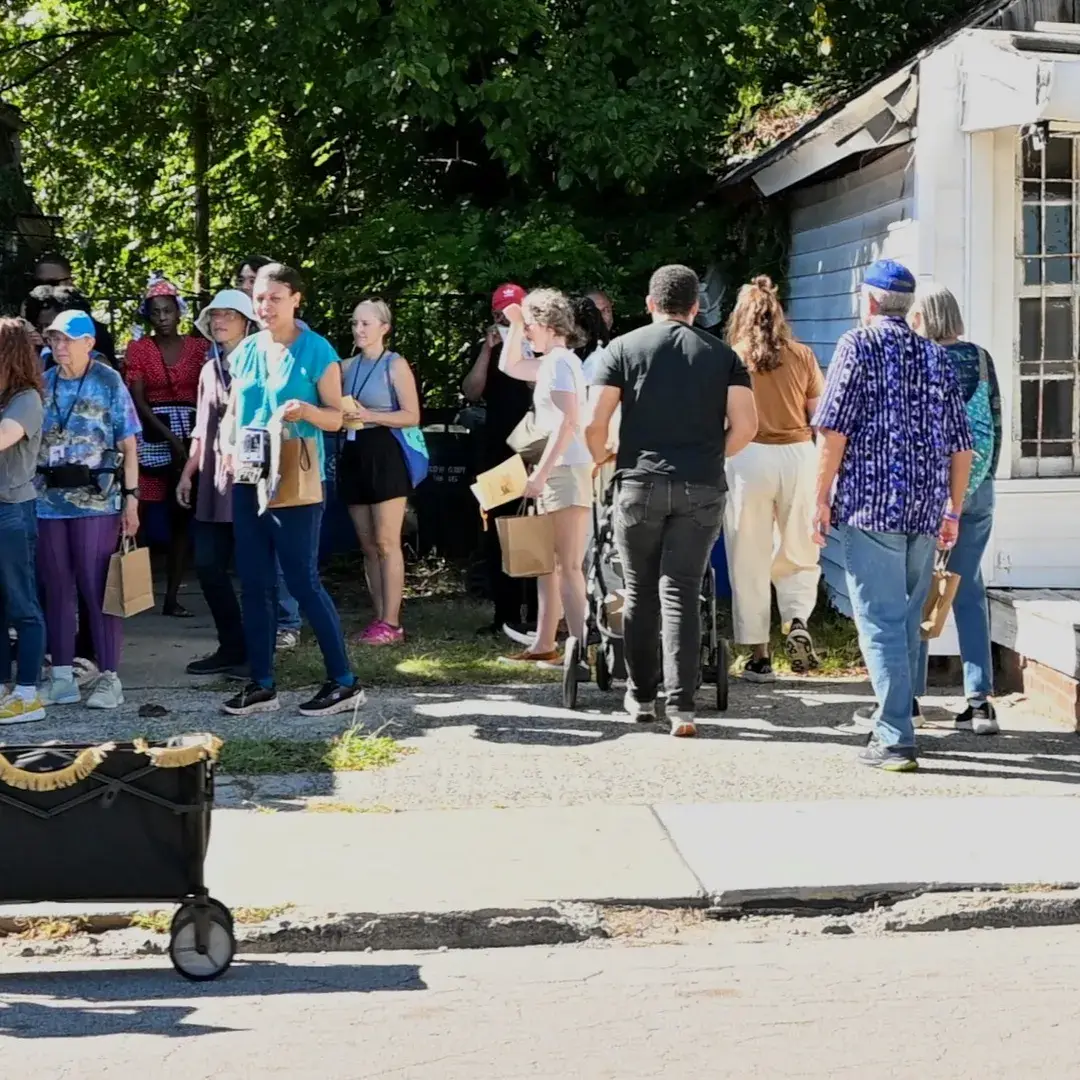
What an amazing turnout for our inaugural Queer History of Durham tour on November 8th! We had a great time learning more about the queer History of Durham, enjoying the incredible zine created by Kelsey Graywill and Meg Lentz, and a social hour at the Pauli Murray Center.
Photo courtesy of the Schlesinger Library at Harvard University
Reach out to jlasure@preservationdurham.org if you’re interested in hosting this tour for your organization. You can take the tour on Open Durham, or book a private tour for an adapted walking tour version. You can also enjoy the zine commissioned in collaboration with the Duke Human Rights Center on the Open Durham website. Kelsey Graywill of Hyperlocal Durham turned the zine into an interactive game.
“Merrick-Moore was designated as Durham’s inaugural Heritage Community, a program created by the city’s Planning and Development Department to honor communities that have never been formally recognized by the city or county. The goal is to celebrate communities and help them gather research so they can apply for future local or National Register designations if eligible. Merrick and Moore cofounded North Carolina Mutual Life Insurance Company, the cornerstone of Durham’s Black Wall Street and the country’s largest African American life insurance company.
On November 1, community members gathered for a ceremony unveiling a historical sign outside Mount Zoar that details some of the neighborhood’s prominent places and celebrating the designation.” Full story by Kennedy Thomason on indyweek.com
We invite you to take a spatial journey through this vibrant community with interactive maps, photos, and oral histories from residents by clicking the StoryMap below:
Originally built for Henry and Laura Burnett from Chatham County, 1208 Fayetteville Street was the family home for the Burnetts until 1978. It was also the childhood home for their children, Catherine, Blanche, Frank, Nannie, and Henry. Catherine and Blanche passed away young, both in their 20s. Frank stayed in Durham and was the principal of numerous schools, including Burton Elementary (formerly East Durham Colored School, which he helped rename), Lyon Park School, and W.G. Pearson School, where he retired from. Nannie moved to Denver, Colorado, where she taught P.E. at Mitchell Elementary School and won numerous awards for her volunteer work in Denver. Henry served in the United States military and was awarded the “Soldier’s Medal,” for heroism. Henry went into social service work and moved to Greensboro to work for the Guilford County Department of Social Services.
Henry and Laura Burnett House
1208 Fayetteville Street c. 1916
1208 Fayetteville included additional apartments for numerous boarders, including Boisie McIntosh, Ector Williams, and Raymond Long. This home is steeped in the Burnett family history, along with the boarders who lived with them throughout the years. We’re delighted to document the history of 1208 Fayetteville and recognize the Burnett family and their contributions to the Durham community.
206 East Hammond was built on a lot purchased from the Durham Realty & Insurance Company in May 1928. It was part of a small cluster of homes before many more residences were built in the now called Northgate Park after the Great Depression. A detached two door garage and a built in telephone wall niche reflect the accommodations for new technology. Over a dozen families called this home over the decades. William Marion Marshall was a widower who conveyed property he owned on North Gregson Street to acquire the home for his children. He worked at American Tobacco for almost 40 years. After Marshall’s passing, Norma York Dickson and her husband James Edward Dickson Jr. moved in with their family. The couple got married on West Club Blvd and were active in education and health initiatives in Durham. Both the Marshalls and the Dicksons are buried at Maplewood Cemetery.
The large front gabled dormer and cross gabled roof are lovely examples of the Craftsman bungalow era. The stucco exterior is more unique than the typical wood siding of other homes built in the area in the 1920s. Learn more about this home and the families who lived here on Open Durham.
This bustling Old North Durham home was built for Oren and Bessie Belvin and their children in the 1920s. The new house replaced the original wood frame house with fire-proof construction of 14” thick walls of brick tiles between layers of tapestry brick, as Oren was a brick manufacturer who sold his business Cheek & Belvin to the Borden Brick & Tile Company in 1928. The couple lived here the rest of their lives, along with family, a tobacco warehouse manager, and an African-American cook named Lillie Christmas, daughter of Henry Christmas and Lizzie Carrol.
Dr. Edwin Holt Bowling and his wife Ada Hesse who ran The Afton Inn on Roxboro Road purchased the home in 1945. Ada, her sister Nettie, and Nettie’s daughters ran a boarding house called Kenloe Manor from 918 North Mangum during the 1950’s-60’s.
The property had several more owners, including Nina Jannetta Rota and her family and Frank L. Byrd an electrician. It was empty before being renovated in 2004 to carefully restore it back to a single-family home highlighting original architectural features. The “Kenloe Manor” stone and cement mosaic is still visible in the front yard.
Local events and news from us and our partners in preservation you may be interested in.
- Join Friends of Geer Cemetery Saturday 1/3/26 & 1/10/26 from 10am-Noon in maintaining the Historic Geer Cemetery by picking up branches, cutting vines, and removing leaves in this historic cemetery. Bringing rakes, leaf blowers, and tarps is appreciated. Please wear close-toed shoes and gloves.
- Tree Planting and Hiking along the Eno River The Eno River Association is hosting tree planting opportunities, including reforesting an old horse pasture at Rocky Branch Conservation Area on Thursday 1/22/26. Featured events include a New Years Day hike and guided history hikes on Sunday 1/11 & Sunday 2/1.
- Historic Stagville Tours: Historic Stagville is a 165-acre State Historic Site that inspires new understanding about the history of slavery through preservation, interpretation, research, genealogy, and descendant engagement. Guided tours are available Tuesday-Friday at 1pm & 3pm, and Saturday at 11am, 1pm & 3pm. Please call ahead to confirm guided tour availability. An outdoor self-guided tour with optional audio is available during all open hours.
- Bull City Brews: A Taste of Durham’s Past Saturday February 28th 3pm-6pm: Durham has been a city of constant creativity and innovation since 1869. From its origins as a tobacco boom town and home to the most successful Black Wall Street in the country, to its modernization as a place for ingenuity, recreation, and entertainment, Durham has the stories you won't want to miss! Put on your walking shoes as our historic guides take you on a tour through the Bullpen Social District to learn about Durham's past while enjoying beverages from several local spots. Hosted by historians from West Point on the Eno.
- Green space information and resources provided by the Hayti Promise Community Development Corporation:Durham Rooted Faith ProjectRedlining and Greenspace in Durham, NCTree Coverage maps from Durham Neighborhood Compass
Copyright (C) 2025 Preservation Durham. All rights reserved.Want to change how you receive these emails?
You can update your preferences or unsubscribe