Educopia
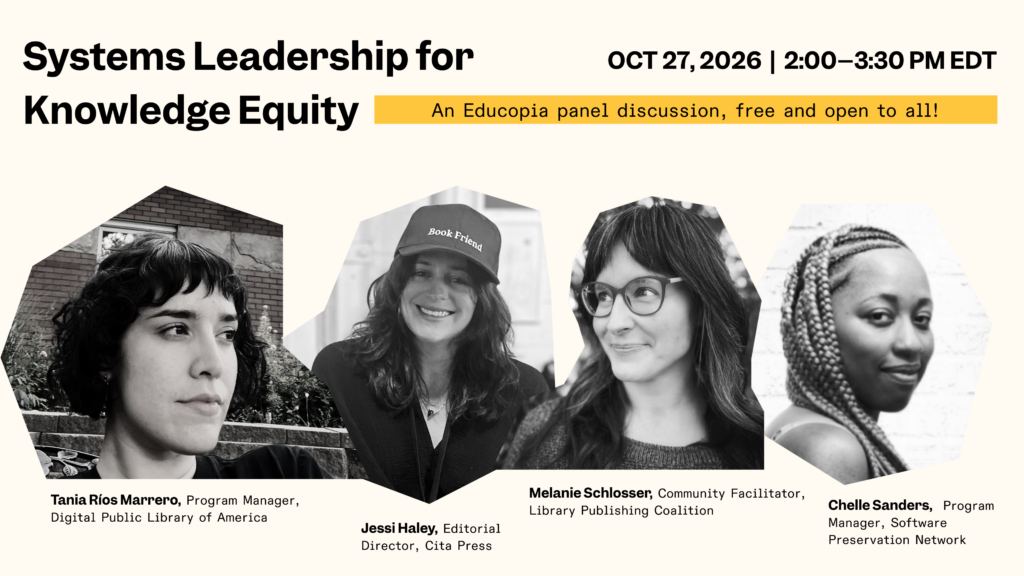
October 27, 2026 [2:00–3:30 pm EDT]: Systems Leadership for Knowledge Equity | An Educopia panel discussion, free and open to all!
![October 27, 2026 [2:00–3:30 pm EDT]: Systems Leadership for Knowledge Equity | An Educopia panel discussion, free and open to all!](https://educopia.org/wp-content/uploads/2026/09/SL-PANEL-BANNER-WEbSITE-scaled.png)
An Interview with Tania Ríos Marrero, Digital Public Library of America [Systems Leadership Interview #6]
Learning Out Loud: Inside Educopia’s New Work Labs on AI and Community-Controlled Infrastructure
Our Work
Stay in Touch
235 Peachtree Street NESuite 400, Atlanta, GA(470) 207-8384
- Free Resource, Panel Discussion, Systems Leadership Series
by Aloma Antao
Click here to register here via Zoom
What does it take to be an effective and ethical leader in challenging times? What does sustainable, community-facing knowledge work look like, and how do we get there?Over the past two years, funding cuts and political pressure have tested knowledge organizations and the people who sustain them. These shocks didn’t create our field’s deepest challenges around sustainability, independence, and equity, but they have brought them into sharp relief, and made it clear that no single organization can solve them alone. This panel brings together four knowledge leaders for a conversation about understanding the systems we work within, leading through relationships and collaboration, and building the collective power we need for a more just and equitable knowledge ecosystem.
Meet the panelists
Jessi Haley, Editorial Director, Cita PressJessi leads editorial work at Cita Press, a feminist, open-access library and press that pairs contemporary authors and designers with public domain texts by women. She previously managed the University of Chicago’s creative writing program and served on the editorial staff of Chicago Review and Colloquium Magazine.Tania Ríos Marrero, Program Manager, Digital Public Library of AmericaTania is the program manager for the Digital Public Library of America. Tania is a librarian and facilitator with 10+ years experience building programs and partnerships across libraries, archives, and cultural organizations, including with the Digital Library of the Caribbean and the Free Library of Philadelphia Foundation. Chelle Sanders, Program Manager, Software Preservation NetworkChelle manages the Software Preservation Network, a distributed, collective effort to ensure long-term access to software through community engagement, infrastructure support, and knowledge generation.Melanie Schlosser, Community Facilitator, Library Publishing Coalition Melanie is the Community Facilitator for the Library Publishing Coalition. She is passionate about the potential of community-driven solutions to address big challenges, and always strives for a balance between getting things done and caring for each other and the community.
Think about the life of a single piece of knowledge: someone decides it’s worth publishing, someone ensures it survives as technology changes, and someone connects it with the people who need it. Our four panelists work at each of these junctures.
Through Cita Press, Jessi Haley recovers and freely shares writing by women that history has overlooked. Melanie Schlosser supports the Library Publishing Coalition’s work toward publishing that is open, inclusive, and sustainable. Chelle Sanders helps the Software Preservation Network keep digital culture accessible even as the software it depends on disappears. And at DPLA, Tania Ríos Marrero centers community knowledge sovereignty and the trust that grows from relational work. Each works in the connective tissue of our field, through member coalitions, distributed networks, collaborative presses, and partnerships built one relationship at a time, which is precisely where systems leadership lives. Their work also spans very different scales, from place-based organizing to international networks and readers who could be anywhere, giving us a rare chance to ask how local and distributed work shape one another.
Why systems leadership, and why now
In the knowledge sector, everything is connected: a funding shift affects staffing, staffing shapes programming, and programming determines who is served. Our challenges, from digital preservation to equitable access, routinely cross organizational and disciplinary lines, yet most of our leadership models were designed for leading within an institution rather than across a system.
Systems leadership offers another way: a set of practices we can deliberately cultivate to lead, and respond to, change at the level where our problems actually live. For Educopia, it’s less a new direction than a name for work our communities have long been doing. As a fiscal host and facilitator for collaborative communities, including the Library Publishing Coalition and the Software Preservation Network, we have always believed that system-wide change requires system-wide leadership. Naming the framework simply makes that work easier to see, teach, and share.
At its heart, systems leadership is a commitment to collective action, expressed through four overlapping practices:
- Understanding the system that shapes our work and the challenges we seek to address
- Building coalitions within and between organizations around a shared goal
- Creating containers for learning and trust, where leverage points for change can surface
- Adapting and innovating to sustain collective action through difficult times
You’ll hear each of these in our panelists’ work, whether it’s Chelle making invisible infrastructure visible at SPN, Melanie uniting some 80+ libraries around shared practice at LPC, Tania’s relational approach to partnership at DPLA, or Jessi’s (Cita’s) free, open-access model.
Where this conversation is building on
This panel builds on a year and a half of learning out loud about systems leadership. Since April 2025, our Systems Leadership Interview Series has featured leaders including Gabriel Solís of the After Violence Project, Gita Manaktala of the MIT Press, Kimberly Jenkins of The Fashion and Race Database, Anne Lee Steele of STUDIO SANSHIN, Madison Snider of Siegel Family Endowment, and, most recently, panelist Tania Ríos Marrero. This summer and fall, knowledge workers also joined our two-part Practicing Systems Leadership workshop to map change together and practice leading from where they are.
Interviews let us go deep with one leader at a time, but systems leadership really happens in the space between people and organizations. A panel puts that practice in motion. By bringing four leaders into dialogue with one another, we hope to surface shared interests, see the system from new angles, and perhaps spark a few new collaborations along the way.
The conversation will weave together three threads:
- Finding your place in the system: how each panelist understands their niche in the wider knowledge ecosystem, how recent pressures have exposed structural inequities, and what influence they hope to have in return.
- Small scale, big systems: what hyper-local work can teach us about larger systems, what “local” means for communities that are diasporic, distributed, or digital, and whether scaling up is even the goal.
- Leading with, not over: what it takes to build power together through relationships and coalitions, and who else is leading with courage in this moment.
Beneath all three runs a question our field can no longer set aside: what does sustainable, fairly compensated, community-facing knowledge work look like, and what will it take from each of us to get there?
Join us!
You don’t need a leadership title to belong in this conversation. If you work in libraries, archives, museums, publishing, preservation, or the infrastructure that connects them, we hope you’ll bring your questions, your experience, and your hopes into the room with us.
Systems Leadership for Knowledge Equity: Tuesday, October 27, 2026 · 2:00–3:30 pm EDT · Free and open to all · Register now